The Woodruff Gun
Annotations to the Margreiter article.
Update on the Golden Hill Woodruff.
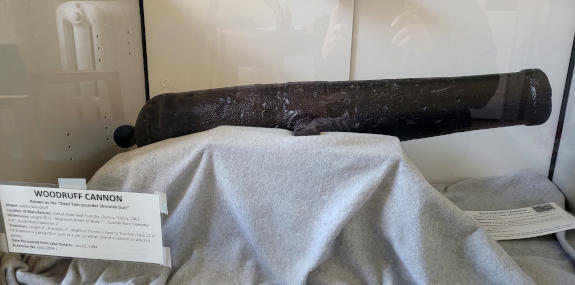
A visit to the Golden Hill State Park lighthouse museum on October 29, 2026, revealed that the museum has upgraded its display of their Woodruff tube with interpretive panels.
A large plaque is now mounted on the wall above the display case with a brief history of the Woodruff gun and additional information about this tube’s discovery and recovery.
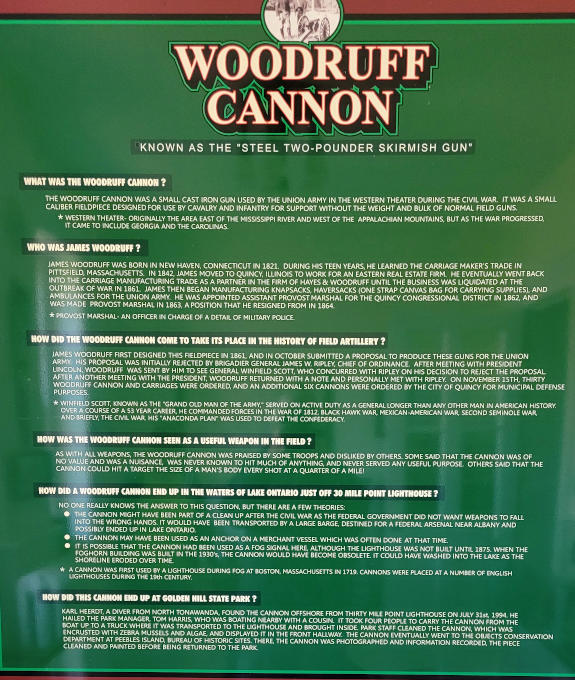
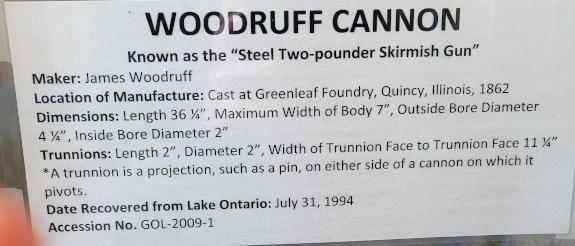
Transcription:
WOODRUFF CANNON
Known as the “Steel Two-Pounder Skirmish Gun”
What Was the Woodruff Cannon?
The Woodruff cannon was a small cast iron [sic-they were hammer-forged, not cast] used by the Union Army in the Western Theater during the Civil War. It was a small caliber fieldpiece designed for use by cavalry and infantry for support without the weight and bulk of normal field guns.
*Western Theater—Originally the area east of the Mississippi River and west of the Appalachian Mountains, but as the war progressed, it came to include Georgia and the Carolinas.
Who Was James Woodruff?
James Woodruff was born in New Haven, Connecticut in 1821. During his teen years, he learned the carriage maker’s trade in Pittsfield, Massachusetts. In 1842, James moved to Quincy, Illinois[,] to work for an Eastern real estate firm. He eventually went back into the carriage manufacturing trade as a partner in the firm of Hayes & Woodruff until the business was liquidated at the outbreak of war in 1861. James then began manufacturing knapsacks, haversacks (one strap canvas bag for carrying supplies), and ambulances for the Union Army. He was appointed Assistant Provost Marshal for the Quincy Congressional district in 1862, and was made Provost Marshal in 1863, a position he resigned in 1864.
*Provost Marshal—An officer in charge of a detail of military police.
How Did the Woodruff Cannon Come to Take Its Place in the History of Field Artillery?
James Woodruff first designed this fieldpiece in 1861 [sic—the tube was designed and manufactured by Miller T. Greenleaf, a metal foundry owner in Quincy. Woodruff is not mentioned in association with the gun until it was proposed to the U.S. Government.], and in October submitted a proposal to produce these guns for the United States Army. His proposal was initially rejected by Brigadier General James W. Ripley, Chief of Ordinance [sic—Ordnance]. After meeting with President Lincoln, Woodruff was sent by him to see General Winfield Scott, who concurred with Ripley on his decision to reject the proposal. After another meeting with the President, Woodruff returned with a note and personally met with Ripley. On November 15th, thirty Woodruff cannon and carriages were ordered, and an additional six cannons were ordered by the City of Quincy for municipal defense purposes.
*Winfield Scott, known as the “Grand Old Man of the Army”, served on active duty as a General longer than any other man in American history. Over a course of a 53 year career, he commanded forces in the War of 1812, Black Hawk War, Mexican-American War, Second Seminole War, and briefly, the Civil War. His “Anaconda Plan” was used to defeat the Confederacy,
How Was the Woodruff Cannon Seen as a Useful Weapon in the Field?
As with all weapons, the Woodruff cannon was praised by some troops and disliked by others. Some said that the cannon was of no value and was a nuisance, was never know to hit much of anything, and never served any useful purpose. Others said that the cannon could hit a target the size of a man’s body every shot at a quarter of a mile!
How Did a Woodruff Cannon End Up in the Waters of Lake Ontario just off 30 Mile Point Lighthouse?
No one really knows the answer to this question, but there are a few theories”
• The cannon might have been part of a clean up after the Civil War as the Federal Government did not want weapons to fall into the wrong hand. It would have been transported by a large barge, destined for a Federal arsenal near Albany [the Watervliet Arsenal] and possibly ended up in Lake Ontario.
• The cannon may have been used as an anchor on a merchant vessel which was often done at the time.
• It is possible that the cannon had been used as a fog signal here, although the lighthouse was not built until 1875. When the foghorn building was built in the 1930’s, the cannon would have become obsolete. It could have washed into the lake as the shoreline eroded over time.
*A cannon was first used by a lighthouse during fog at Boston, Massachusetts[,] in 1719. Cannons were placed at a number of English lighthouses during the 19th century.
How Did This Cannon End Up at Golden Hill State Park?
Karl Heerdt, a diver from North Tonawanda, found the cannon offshore from the Thirty Mile Point Lighthouse on July 31st, 1994. He hailed the Park Manager, Tom Harris, who was boating nearby with a cousin. It took four people to carry the cannon from the boat up to a truck where it was transported to the lighthouse and brought inside. Park staff cleaned the cannon, which was encrusted with zebra mussels and algae, and displayed it in the front hallway. The cannon eventually went to the Objects Conservation Department at Peebles Island, Bureau of Historic Sites. There, the cannon was photographed and information recorded, the piece cleaned and painted before being returned to the park.
A descriptive label was added to the display case.